Monday, September 25, 2017

BENUE FLOOD: EXCITMENT AS VICTIMS GET RELIEF MATERIALS FROM UNILEVER


As part of its efforts to make sustainable living commonplace, Unilever Nigeria has complemented government’s efforts at relieving people affected by the recent flooding in Benue State.

The company demonstrated this through the donation of products to the people of the state at the IDP camp.
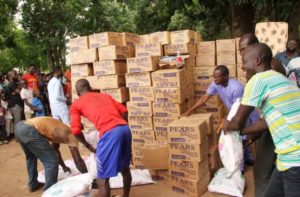


The Unilever team led by Tomiwa Asaolu, the company’s External Affairs Manager was accompanied by other members of staff and key distributors. They met with the State Deputy Governor, Engineer Benson Abounu and camp officials to take a tour around the facility before making their donations.

The donation which comprised daily essential needs such as body creams, tooth pastes, food items and other necessities were received with excitement and genuine appreciation by the camp residents.

The Deputy Governor while receiving the gifts, thanked the company for the gesture, describing it as timely and most needed at their crucial period. Asaolu, in his response, appreciated the officials of the camp for the warm reception and the opportunity given to Unilever to extend a hand at a time like this.
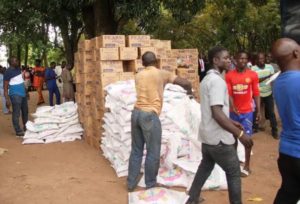


He mentioned that, “Unilever is committed to making a positive impact in many ways; through our brands, our operations and relations, through voluntary contributions, and various ways we engage with our stakeholders. Also present at the donation were Dr. Mrs. Cecilia Ojabo, Benue State Commissioner for Health and Human Services; Mr. Boniface Ortese, The Executive Secretary, Benue State Emergency Management Agency, BESEMA, Sam Uche, Key Distributor and Mr. David Ebah, Regional Sales Manager, Middle belt, both of Unilever Nigeria Plc.

The camp which was set up following the floods in the State currently shelters over 4,000 persons. The flood incident, according to the Benue State Emergency Management Agency, affected over thousands of people in 24 communities and over 2,769 households including Makurdi, the state capital. 


The donations of Unilever Nigeria to the people of Benue will go a long way in complementing government’s efforts at bringing succour and relief to the beneficiaries.

Labels: , ,

Saturday, September 16, 2017

Benue Flood: Two weeks after, it’s still pains, anguish and sorrow for displaced victims


At 6:00 p.m. on September 4, Dan Kwen and his comrades served free meals to a row of homeless persons at a makeshift camp in the premises of a high school in Makurdi.
Unlike the few dinners preceding it, this night is one devoid of merriment. Understandably.

This night is different because Mr. Kwen and his men mutter a caveat with every bowl dished to the beneficiaries which could read as: You have just been served your last meal because this camp is shutting down tonight.

“This is where I have fed myself and my two children since last week,” said a grim-faced Helen Tseke, 51.

“I appreciate their effort, but I am fearful about how we’ll survive in the coming days.”

Mr. Kwen’s non-profit, Benue We Deserve, was amongst the earliest responders to Mrs. Tseke, her children and thousands of other victims of the August 27 flood that devastated Makurdi and other settlements in Benue State. They chose not to go to a camp for displaced persons because they believe they’ll be worse off there.

But after five days, the group decided to shut down its first camp which opened inside Padopads Secondary School in downtown Makurdi on August 30.

Its resources were fast running out.


“We have decided to shut down this place because our resources are fast draining and we still intend to open at least one more feeding camp in other neighbourhoods affected by the flood,” Mr. Kwen told PREMIUM TIMES.

An estimated 573 victims, who fed there twice daily for the few days the camp was opened, were affected by its closure. The closure came after the NGO appealed for funds, but only a few people responded in kind.

FERTILE BUT FRAGILE

The town of Makurdi sits in a naturally fragile terrain located in a cleft in a marshy valley that bends on the rice-growing plains on the south bank of River Benue, the longest tributary of the River Niger.

Larger geographically and more populous than most of the 36 states of the federation, Benue State, where Makurdi is the capital, is Nigeria’s acclaimed food basket.


It does better in agriculture than any other state – growing large quantities of rice, yams, groundnuts, sesame, cassava, sorghum, shea nuts, millet, cotton amongst others.

But perhaps due to the perennial inability of its leaders from decades past to maximise its agriculture potentials, the state has remained amongst the poorest in the country.

The state also appears to have been drained of its young, vibrant men, who abandoned it for better economic prospects in Abuja, Lagos and elsewhere, leaving behind mostly old and barely educated young persons.

Benue State is occupied predominantly by the Tiv, one of Nigeria’s largest minority ethnic groups, with the Idoma coming second.

Asides its rich agrarian history, little is known about the present Benue State pre-colonial era. But its fortune peaked when Makurdi was made the gateway to northern Nigeria with the construction of a massive train station here in 1932.


The colonialists had taken interest in the people of Benue more than a century earlier when a touring Mary Slessor and her entourage of campaigners against the killing of twins dropped by.


With its mist-shrouded valleys and lush plains, the picturesque scenery around Benue is breathtaking and its land naturally fertile.

But with its hard showers and heavy flooding, its capital Makurdi and surrounding communities now look like they were made a dumping ground for refugees.

Water, water everywhere
In the early hours of August 27, a torrential downpour caused the River Benue to breach its banks across the marshy plains around Makurdi, washing off a deluge of muddy water into thousands of homes overnight.

The problem was compounded by rainwater from the upper side of the town that poor drainage system hindered from finding its way through the swamps into the River Benue, trapping in the low-level areas.

At dawn, residents around the low-level areas found themselves stepping into a pool of water when they woke up from their beds. In some places, waist-high flood unloaded snakes, alligators, and other deadly reptiles into homes.


A few days before the flood, the Nigerian Meteorological Agency gave advance warnings to state authorities, but it is yet unclear why people failed to evacuate.

The government said it advised residents to evacuate via a radio broadcast, but many residents disprove this, saying no announcement came before the downpour.

The aftermath saw an estimated 110,000 residents dislodged from their homes; while many lost their cars, electronics and other valuables.

Four sophomores at Benue State University who live in Gyado neighbourhood said their academic documents were destroyed by the flood. They stayed behind at school hoping the ongoing nationwide strike by lecturers won’t linger for too long.

“Very few houses were spared,” said Ayila Idye, a district ruler whose domain was hard hit.

“I have been seeing flooding, this type is a first,” he adds.

Mr. Idye, 71, said the extent of the flooding easily outpaced that of 2012, which was primarily blamed on the opening of Lagdo Lake Reservoir in Cameroon that September.

Makurdi is subdivided into high-level and low-level districts, and the latest flood is said to have affected almost all the neighbourhoods in low-level.


Amazingly, unlike its 2012 variant that left at least 30 dead, no death was recorded in the August 27 flood, which affected at least 13 local government areas across Benue State. But the incident prompted an instant national emergency.

On September 1, President Buhari ordered the National Emergency Management Agency, NEMA, to provide immediate support. By September 7, the agency had delivered eight trucks of relief materials to the state, with about five more said to be in the works, according to Paul Ohemu, an air force commander who coordinated NEMA’s emergency response.

Before the president’s intervention, the flooding had sparked a wave of sympathy amongst Nigerians, with many rendering support.

Although the state has a history of disaster and has been hit hard by floods in recent years, this was arguably the first time that images of a major disaster were fervently distributed on social media in real time, eliciting strong feelings even in a country that is hardly spared a daily dose of bad news.

Millions of naira poured in after appeals on social media. Some individuals, from musician TuFace to businessman Aliko Dangote, also made significant contributions.

Camp opens for the internally displaced

Magistrate Jimmy, 36, is still bewildered days after his daughter nearly drowned.

“I almost didn’t know that the water was about to cover my daughter on the chair she was sleeping,” he said. “I thank God I was able to save her.”

Like thousands of families who were sacked from their homes, Mr. Jimmy now lives in a temporary shelter not far from the scene of destruction, in a redundant market opened hastily after the flood to house the homeless.


Built in long rows, the brick buildings are identical. About 600 stalls are in the market premises, which was built by former Governor Gabriel Suswam but never put to use because traders deemed it too expensive to rent.

Each of the stalls has a solitary opening punched in the wall —ostensibly for cross-ventilation. Inside, there are no lightbulbs or fans.

Four families are paired together per stall, but not all the empty stalls are occupied. As at September 6, almost all the occupants have been given either a mattress, a mat or both.

The facility is being managed by the Red Cross, Benue State Emergency Management Agency, BSEMA with support from the Federal Government through NEMA.

Charity group, Benue NGO Network, Bengonet, an umbrella body for non-profit organisations in the state, coordinates supply of food items, drinks and other essentials brought to the camp by some of its 86 affiliated organisations.

Mr. Kwen’s group is affiliated with Bengonet. After serving free meals to victims at two other neighbourhoods, he moved to the camp on September 10 to support Bengonet’s efforts inside. People like Mrs. Tseke and others who are not at the camp have returned to their homes.

For safety reasons, cooked foods are not allowed into the camp, because of ‘‘bad people who may want to bring poison’’ into the camp, said Governor Samuel Ortom.

The Nigerian Air Force, which has one of its largest bases in Makurdi, has a squadron of medical doctors and nurses at the camp. An estimated 351 persons were treated for different random illnesses between August 31 and September 5, including five diarrhoea complaints, according to statistics compiled by the Air Force for PREMIUM TIMES.

As at September 5, less than 5,000 of the estimated 110,000 victims had registered for shelter at the camp. Many families stayed away from the temporary facility, preferring instead to remain close to what is left of their homes.

But many of the people who were in the camp said they were happy to have shelter and brought what they were able to salvage from their homes.

Meals were heated with charcoal on the concrete outside the stalls and sometimes shared with neighbours. With the support of UNICEF, water was no longer in short supply.

But there were complaints from the victims that emergency workers, especially Bengonet staff, were stealing food items through the fence at dusk.

Bengonet denied this claim.
If there were crooks amongst aid workers, they would encounter little impediment in smuggling food out of the camp. The premises is protected only by a perimeter fence that is not more than six feet tall.

Emergency officials have since stopped admitting people into the camp, but those already in will remain there for as long as it takes. A similar one that was opened after the 2012 flood was run for more than four months.

Victims of the flood who were not registered at the camp were being registered at their neighbourhoods as at September 7. They, alongside those at the camp, are potential beneficiaries of future compensation by the government, even though it is yet unknown when such restitution would come or how much.


CREDIT: PREMIUM TIMES

Labels: , ,

Tuesday, September 12, 2017

BENUE FLOOD: AIR FORCE TREATS 600 VICTIMS IN IDPs


The Nigerian Air Force has administered free treatment to no fewer than 600 Internally Displaced Persons (IDPs) affected by the flood in Benue.

Jeremiah Amase, Head of the medical team at the camp, told the News Agency of Nigeria (NAN) on Monday in Makurdi that the patients treated so far were suffering from hypertension, malaria, diarrhea, upper and lower respiratory infections among others.

The News Agency of Nigeria (NAN) reports that Chief of Air staff, Air Marshal Sadiq Abubakar, had earlier inaugurated the “Medical Outreach Programme” to assist IDPs as part of the Nigerian Airforce’s (NAF) social responsibility to the people of the state.

Mr. Amase, a squadron leader, explained that the patients attended to responded to treatment.

NAN reports that the NAF is collaborating with the state government, UNICEF and other international and local organisations to assist the flood victims.

More than 100,000 were displaced by recent flooding in Benue with 5,000 staying at IDP camp.

Labels: , ,

Monday, September 11, 2017

BENUE FLOOD: DANGOTE DONATES N250 MILLION TO VICTIMS


The Chairman , National Committee on Flood Relief and Rehabilitation , Alhaji Aliko Dangote , says he has provided N250 million as relief assistance to victims of the devastating flood in Benue State .

Dangote said on Sunday in Lagos that this was in response to the request by the Benue State Government.

He said that the committee had also approved the release of one of its completed IDP Hostels in the state as a temporary shelter for some of the displaced people.

Former President , Goodluck Jonathan had on Oct . 11 , 2012 , inaugurated the Dangote - led 34 - member National Committee on Flood Relief and Rehabilitation .

The committee was charged with raising additional funds to support the government ’ s efforts to provide adequate relief and post- impact rehabilitation to persons and communities affected by floods in the country.

Dangote said the State Emergency Management Agency had disclosed that more than 110, 000 people in 24 communities , including Makurdi , were displaced by the recent flood in Benue .

The committee chairman said that asides the donation to Benue , his committee had also donated N150 million to provide relief assistance to flood victims in Anambra ,

Dangote , in a statement by Mr . Sunday Esan of the Corporate Communication Department of Dangote Group , said that the committee had also released N118 million to the National Emergency Management Agency .

He said that this was to augment the N1 . 6 billion released by the Federal Government for procurement of food and non - food relief materials in aid of flood victims in 16 states .

According to him , the states are Abia , Akwa - Ibom , Bayelsa , Ebonyi , Edo, Ekiti , Enugu , Abuja FCT, Kebbi , Kwara, Lagos , Niger , Ondo, Oyo , Plateau , and Sokoto .

He said that the committee was currently implementing the various projects in the 24 states affected by the 2012 nationwide floods .

Dangote said that the rationale behind the projects was to assist the benefiting states to better handle future emergencies , including flooding .

Labels: ,

Benue Flood: Those criticising Buhari are ignorant – Governor Ortom


Governor Samuel Ortom has described Nigerians who slammed President Muhammadu Buhari for failing to visit Benue State following the August 27 flood disaster in the state as ‘ignorant,” adding that they lacked basic knowledge of how government runs.

“Those people who are criticising are completely ignorant of what governance is,” Mr. Ortom told PREMIUM TIMES in an exclusive interview at his official residence in Makurdi Thursday.

Mr. Ortom said the president acted promptly after receiving news of the development, a gesture he believed was sufficient.

“Immediately after the thing happened, I instructed the Director General of National Emergency Management Agency who then informed the president,” he explained.

“As soon as the president got the message, he directed the DG to move to Benue and the next day the DG arrived with relief materials.”

The governor said the criticism was misplaced, given that Vice President Yemi Osinbajo had also visited the state to identify with the victims and assured them of federal government’s support.

“Those who are criticising are not from Benue State,” he added.

Mr. Buhari was at the receiving end of some social media outrage throughout last week, after failing to visit the state days after the August 27 flood which displaced an estimated 110,000 people in 46,000 households.

Labels: , ,